Starting the day I received our projected plan through Spain the name O Cebreiro loomed in my head. The ascent looked like an exponential curve at the end of the day and scared me to my bones...I do not like hills. To make matter worse, O Cebreiro was to be the longest day we had hiked so far and we were to ascend the mini-mountain after walking what was generally a normal day for us.
In preparation for what someone in our group called "The Big Game", we awoke at the very medieval hour of five (that´s 11 PM NYC time, so hopefully we were all adjusted to the time difference). The day was cool and dark as our group coasted along the highway, stopping in small towns to enjoy rare Fair Trade coffee, a bathroom break or simply a rest for tired feet. Everyone wanted to go nice and easy in preparation for the trip. We also had a second motivation to slow things down, for the first two peregrinos in O Cebreiro had to stay in the public hostel, while the rest of our crew had rooms reserved in a hotel. (The pilgrims who stayed in the hostel have reassured me that it was actually very nice and none of us had to fear).
A highlight of the day came when our group stopped for snacks and rest at the foothills of O Cebreiro and Kevin Soravilla raised our spirits with a rallying speech. Kevin told us,
"Men and Women of Fordham arise! Before us stands a mighty and perilous mountain. Though many before us have fallen, take heart, we shall prevail, for we are of Fordham. By day´s end we will be feasting in fair O Cebreiro, atop the belly of the foul beast. Show no fear, no mountain can stay our stride! Arise brave pilgrims, to the summit of victory we march! Go with God´s blessing and mine!¨
The speech was quite powerful and lifted our spirits, which were then crushed by the mountain. I won´t lie...it was hard. It was hot. I was sweaty. Some peregrinos loved the hike, loved the rush of blood in their ears and the burn in their legs, but I´m just not that kind of girl. As we ascended however, the mountain started to warm itself to me. From one of our resting points we had an amazing view of the valley below and enjoyed a cool mountain breeze. Then as we ascended further we entered a cloud and the mists covered us and cooled our overworked bodies. It was very refreshing, even for a pilgrim such as myself who couldn´t help but wonder where the godforsaken town was.
Finally, just when I thought I would go mad, O Cebreiro appeared from the mists. It felt like I had journeyed from the summer in Spain to the late winter in Ireland or Scotland in the matter of an afternoon. O Cebreiro is a town with Celtic origins, so bag pipes were playing, and it is very cold and snowy in the winter, so the ancient pallozas (round huts with straw roofs) were built solidly, to conserve heat and protect from winter´s winds. It was different, but beautiful and refreshing. I for one was happy to be cold again, and to not wear sunscreen for once.
While in O Cebreiro we also had a quick tour of the town, as we stood huddled for warmth in the entryway to Santa Maria del Real, a medieval church which is both the site of a Eucharistic Miracle and the home of an argued Holy Grail. The story of the Miracle is quite interesting. The legend tells that a poor farmer struggled through the snows one winter´s day in order to attend mass. He arrived during Mass, as the priest was about to perform the Eucharist and the non-believing priest belittled him and asked why he had risked his life for a piece of bread and a sip of wine. At that moment, the bread became real flesh and the wine became real blood and the magic of the Eucharist was reaffirmed. It´s a little gruesome, but a cool story. We also learned that our hotel was a famous pilgrim hostel and used to be the monastery of the church.
I know few people really enjoyed getting to O Cebreiro, but I think everyone enjoyed being there and it really was almost magical the way the mist obscured our view of everything more than 100M away.
Diana Moore
Monday, June 7, 2010

Sunday, June 6, 2010
Villafranca del Bierzo (Cerezas y Cervezas)

Today we journeyed from Ponferrada to Villafranca del Bierzo. This well-preserved (yet unfourtunately hilly) town is the last we will be stopping in before reaching Galicia. Feeling somewhat epic and courageous after "playing castle" in Ponferrada, we were ready for a much longer day of walking. Our first strech was a shortcut through a somewhat depressing main street populated mostly by empty building, furniture stores, and car dealerships. However, once we rejoined the Camino route we were rewarded by the rolling hills of Spain´s El Bierzo wine region.


Fortified by our snack, we forged on to Villafranca only to be met with...more cherries! Emilee charmed yet another Spainard into giving us and entire tree branch of fresh ripe cherries.

Finally, we reached Villafranca del Bierzo. We were immediately greeted by the sight of the Iglesia de Santiago, a twelfth-century Romanesque church made famous by the Puerte del Perdon or ¨Door of Forgiveness.¨This northern entrance is granted the same spiritual grace as the cathedral in Santiago so that pilgrims near death could receive the same indulgence as those who reached the Camino´s final destination. The door is closed now but luckily none of us had to use it anyway.
Nearby the Iglesia de Santiago is the Castillo de Villafranca. This castle is considered to be one of the best-preserved castles in the El Bierzo region and was built by the Marquesado de Villafranca in the late fifteenth-century. It is now privately owned so we could not go inside and play castle, but it is still an impressive sight.
As we journeyed to our albergue, we wandered down the Calle de Agua. This narrow (and a bit treacherous, considering that medieval people didn´t have any reason to build sidewalks in anticipation of motor vehicles) contributes to Villafranca del Bierzo´s medieval charm. Once inhabited by the nobles of one of Villafranca´s marquesados, Pedro Alvarez de Toledo, the houses bear the many crests of these medieval families. I like to think of it as a medieval lawn ornament.
Finally, we reached our albergue and went out to lunch as a group. Naturally, we shared a few bottles of the region´s famous wine. Between lunch and touring the city, a few of us decided to lounge around on the banks of the River Burbia. After cooling our aching pilgrim feet, we watched the clouds and identified some Camino arrow-shaped clouds in the sky. Perhaps the universe is encouraging us on our way to Santiago de Compostela!
During our tour, we also visited the Iglesia de
At the end of the day we shared a lovely picnic dinner in the town square. Dr. Gyug talked to us about the next day´s walk to O Cebreiro. Notice the upward hand motion. Yikes! Diana will tell you all about our arduous climb to this Galician town in the next blog post.

(Note: I have a few more pictures to illustrate this post, but albergue computers are not exactly lightening speed and they are talking forever to load…check back and I will post them soon!)
Katie J
Friday, June 4, 2010
Fellowship of the Camino: Lord of the Rings Cast List
While bored on the trail we have come up with several character matches for different movies and stories for the pilgrims of our group, perhaps the most extensive is that of Lord of the Rings. Due to the previous mentions of Tolkein jokes and comparisons we felt it was important to share these thoughts.
Diana: Merry
Kevin S: Pippin
Mike: Gimli
Kevin C: Boromir
Reed: Faramir
Katie J: Haldir
Katie B: Elrond
Lucy: Galadrial
Sarah: Eomer
Liz: Eowyn
Maryanne: Arwyn
Emilee: Tom Bombadil
Colleen: Prince Imrahil
Signs and Wonders
As properly penitent pilgrims, we've experienced a number of signs, wonders, omens, miracles, etc., sometimes of unclear intent. Nevertheless, like good chroniclers, we record them for future generations:
- A fountain which appeared outside of San Martin del Camino when wished for.
- An apparition of Jesus on a wayside cross (who wanted 1 euro for a photo).
- Bird signs: a baby swallow making its first flight successfully, some hawks, and many, many storks.
- A charitable hermit atop a plateau at the Casa de los Dioses, a shack, who appeared to supply us with free water, fruits, and cookies.
- Kevin S.'s continued presence with us after Ponferrada.
- Katie' B.'s gift of tongues to converse with French people despite previous ignorance of French.
More to come...
Molinaseca: A Katabatic Journey


The trip to Molinaseca could be described as trying at best and there are not words for the worse. The morning began with a steady uphill into the fog/clouds. Up the mountainside we journeyed, onward into the mists. As we topped the cloud cover on the mountains there was a starkly beautiful view of the sky half grey with cloud and half brilliant blue. But the descent did not end, it continued on, through a series of winding paths, difficult rocky steps, and lovely wildflower fields.
At the top of the first peak there was the Cruz de Ferro, the Iron Cross. At the base of the cross is a massive pile of rocks, each brought by a pilgrim from their homes and left behind on the mountain top. Then a descent began, it was mostly gentle at this point and in the company of Liz, Reed, Lucy, and myself we formed something of a singing quartet to pass the time.
Due to the amount of songs we performed other pilgrims began referring to us as the singers from New York, which was rather entertaining.
Onward we tread into Majarin which sported the an avid supporter of the Templar and his store/lodge. Kevin S. of course spent a good deal of time there... The rest of the town was something of a ruin, as were most of the towns in the area.
Up we went again, and finally down, and what a down. The descent lasted for approximately 1000m closer to sea level.
Thursday, June 3, 2010
Ponferrada: The Order of the Knights Templar vs the Kingdom of France
Never had a more noble host of peregrinos assailed the majestic walls of Ponferrada.
Today we completed the journey to Ponferrada, a town of great importance along the Camino, the cultural center of Él Bierzo region and the last major city before Santiago. The name Ponferrada is derived from the period of Roman occupation, (Pons Ferrata) literally referring to iron supports added by Roman engineers to a main bridge travesing the River Sil.

During the reign of Augustus the town grew to great prominence as a center of gold mining making great and frequent use of the nearby mines of Las Médulas. The great Roman chronicler Pliny refers to the process by which the Romans mined as "The ruin of the mountain". Roman engineers would empty large volumes of water into the canyons, breaking up the rock and allowing miners to sift through the upturned sediment to find gold. Following the Visigothic conquest of Spain the mines fell out of use and the town fell into disrepair.
 The town again emerged into prominence as a stopping point along the Camino de Santiago. In 1178 control of the town was gifted to the Poor Fellow Soldiers of Christ and the Temple of Solomon; better known as the Templars, as a gift for their successful participation in the Reconquista. Once under the stewardship of the Templar Order the town´s walls were greatly expanded and improved and its iconic castle began to take shape. The now famous Castle of Ponferrada served as the headquarters for the the Grand Master of the Castilian priories of the Order.
 The Templars themselves were a monastic order dedicated to the Crusades. Saint Bernard describes these warrior monks as "A new knighthood", devoted to the true Lord, Jesus Christ and not to any fallible, feudal authority. The order became answerable only to the Pope himself and quickly grew in wealth, prestige, and importance. Not only an elite fighting force on fronts in the Holy Land and Spain, but the Order´s massive wealth came to rival and surpass many of the great kingdoms of the middle ages. It is very possible to conclude that the Order reopened operations in the long abandoned Roman gold mines and used this newly acquired gold to finance the construction of the castle as well as many of the great cathedrals and churches of the Kingdom of Leon.
The Templar dominion over the castle and town of Ponferrada ended in 1308 when the Grandmaster traded its control to Prince Philip in exchange for protection and safety during the upcoming purge of the Order. Following the disbanding of the Order and the return to royal control, continued renovations were made to the castle by the various counts and lords who held dominion over the Bierzo region. Finally in 1486 Ponferrada was absorbed into the Crown of Spain where it would remain.
A second major site of the city is the Basilica of the Virgen de la Encina. The beautiful 16th century Renaissance church was built to house a wooden relic portraying the Virgin and Child, supposedely carved by the hands of Saint Luke the Evangelist. According to legend the relic was lost in Spain during the early middle ages, only to be found in the forest by the Templars while cutting down a tree to be used in the restoration of the castle. Sadly the "true" relic has since been lost and a replacement has been constructed to take its place. The Virgen de la Encina has come to be a powerful local devotion attached to the region.

Being a young and ambitious medievalist with a great Templar obsession, today was beyond a doubt my favorite stop thus far along the Camino. Not only a great day to rest my feet after the hard climb yesterday, our group decided to play a game of Templars vs the French Government on the open fields of the old castle courtyard. With a shout of "Deus Vult!" the two armies charged forward into a pitched battle of pretend steel, invisible shields, and vain glory. Despite protestations from both sides, the match was declared a draw and a glorious Chansons de Gest was composed to honor the occasion. As expected I was remembered for bravely leading the Templars into the fray as Kevinis the Pious. The Castle stamp also contributed to a glorious afternoon as it is by far the most epic Camino stamp in the land. Buen Camino!
In honor of the Templars, I write this blog post keeping in mind that this page is "Non Nobis Domine". Kevin the Pious, Grandmaster of the Templar Order
Today we completed the journey to Ponferrada, a town of great importance along the Camino, the cultural center of Él Bierzo region and the last major city before Santiago. The name Ponferrada is derived from the period of Roman occupation, (Pons Ferrata) literally referring to iron supports added by Roman engineers to a main bridge travesing the River Sil.

During the reign of Augustus the town grew to great prominence as a center of gold mining making great and frequent use of the nearby mines of Las Médulas. The great Roman chronicler Pliny refers to the process by which the Romans mined as "The ruin of the mountain". Roman engineers would empty large volumes of water into the canyons, breaking up the rock and allowing miners to sift through the upturned sediment to find gold. Following the Visigothic conquest of Spain the mines fell out of use and the town fell into disrepair.
 The town again emerged into prominence as a stopping point along the Camino de Santiago. In 1178 control of the town was gifted to the Poor Fellow Soldiers of Christ and the Temple of Solomon; better known as the Templars, as a gift for their successful participation in the Reconquista. Once under the stewardship of the Templar Order the town´s walls were greatly expanded and improved and its iconic castle began to take shape. The now famous Castle of Ponferrada served as the headquarters for the the Grand Master of the Castilian priories of the Order.
 The Templars themselves were a monastic order dedicated to the Crusades. Saint Bernard describes these warrior monks as "A new knighthood", devoted to the true Lord, Jesus Christ and not to any fallible, feudal authority. The order became answerable only to the Pope himself and quickly grew in wealth, prestige, and importance. Not only an elite fighting force on fronts in the Holy Land and Spain, but the Order´s massive wealth came to rival and surpass many of the great kingdoms of the middle ages. It is very possible to conclude that the Order reopened operations in the long abandoned Roman gold mines and used this newly acquired gold to finance the construction of the castle as well as many of the great cathedrals and churches of the Kingdom of Leon.
The Templar dominion over the castle and town of Ponferrada ended in 1308 when the Grandmaster traded its control to Prince Philip in exchange for protection and safety during the upcoming purge of the Order. Following the disbanding of the Order and the return to royal control, continued renovations were made to the castle by the various counts and lords who held dominion over the Bierzo region. Finally in 1486 Ponferrada was absorbed into the Crown of Spain where it would remain.
A second major site of the city is the Basilica of the Virgen de la Encina. The beautiful 16th century Renaissance church was built to house a wooden relic portraying the Virgin and Child, supposedely carved by the hands of Saint Luke the Evangelist. According to legend the relic was lost in Spain during the early middle ages, only to be found in the forest by the Templars while cutting down a tree to be used in the restoration of the castle. Sadly the "true" relic has since been lost and a replacement has been constructed to take its place. The Virgen de la Encina has come to be a powerful local devotion attached to the region.

Being a young and ambitious medievalist with a great Templar obsession, today was beyond a doubt my favorite stop thus far along the Camino. Not only a great day to rest my feet after the hard climb yesterday, our group decided to play a game of Templars vs the French Government on the open fields of the old castle courtyard. With a shout of "Deus Vult!" the two armies charged forward into a pitched battle of pretend steel, invisible shields, and vain glory. Despite protestations from both sides, the match was declared a draw and a glorious Chansons de Gest was composed to honor the occasion. As expected I was remembered for bravely leading the Templars into the fray as Kevinis the Pious. The Castle stamp also contributed to a glorious afternoon as it is by far the most epic Camino stamp in the land. Buen Camino!
In honor of the Templars, I write this blog post keeping in mind that this page is "Non Nobis Domine". Kevin the Pious, Grandmaster of the Templar Order
Tuesday, June 1, 2010
Rabal del Camino
Carthago delenda est...
Today we arrived in Rabanal del Camino. It is a small town founded in the 12th century solely for the use of pilgrims on the Camino. We walked up hill most of the way, and though the incline was gradual the steady thinning of air was noticeable. Tomorrow we will reach our highest altitude at 1508m above sea level and the Cruz de Ferro (the Iron Cross).
We have been told that the third day of walking will be the hardest and after this point we will find the days easier and find ourselves with more energy, hopefully this is true. The walking itself maybe tiring, but it is the ground surface which has proved to be the most difficult factor. Asphalt and concrete are to be dreaded as they leave feet aching and joints sore. However in the final kilometer of approach to Rabanal the path turned into a forgiving clay, which was much easier to walk on.
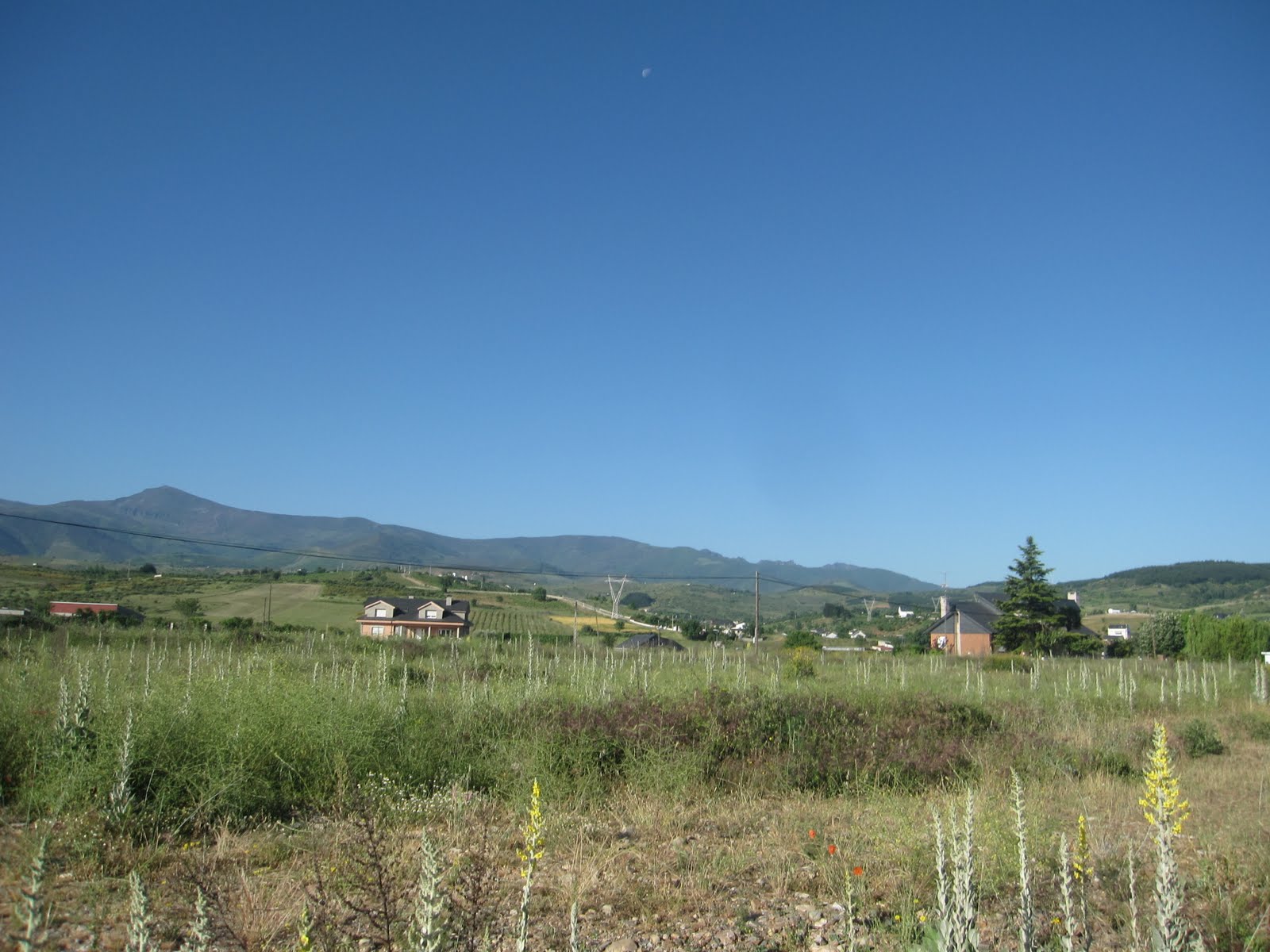
The scenery is, of course, stunning. The day varied from long expanses of flowered fields to quaint towns and villages. The mountains which previously lay ahead move closer around us and loom ever in the distance. Though the area becomes dryer and the plants more desert-ous the view remains surreally spectacular, stretching as far as the eye can see.
We have found the best cure for failing spirits while walking is a song to move to, be it the Battle Hymn of the Republic (an excellent marching song), the entire first act of Les Miserables (which takes up considerable time), or just a chorus of humming the Lord of the Rings theme while cresting a hill (always inspiring); entertainment is never hard to find. There are also, of course, quite times where there is nothing to be heard but the tread of your own feet and the wind about you. I have found that both situations have their benefits be it for camaraderie or introspection.
Tomorrow is a steep up hill followed by a rapid decline into the village of Molinaseca. As both one of the longer and more difficult walks it shall prove to be an interesting experience.
Today we arrived in Rabanal del Camino. It is a small town founded in the 12th century solely for the use of pilgrims on the Camino. We walked up hill most of the way, and though the incline was gradual the steady thinning of air was noticeable. Tomorrow we will reach our highest altitude at 1508m above sea level and the Cruz de Ferro (the Iron Cross).
We have been told that the third day of walking will be the hardest and after this point we will find the days easier and find ourselves with more energy, hopefully this is true. The walking itself maybe tiring, but it is the ground surface which has proved to be the most difficult factor. Asphalt and concrete are to be dreaded as they leave feet aching and joints sore. However in the final kilometer of approach to Rabanal the path turned into a forgiving clay, which was much easier to walk on.
The scenery is, of course, stunning. The day varied from long expanses of flowered fields to quaint towns and villages. The mountains which previously lay ahead move closer around us and loom ever in the distance. Though the area becomes dryer and the plants more desert-ous the view remains surreally spectacular, stretching as far as the eye can see.
We have found the best cure for failing spirits while walking is a song to move to, be it the Battle Hymn of the Republic (an excellent marching song), the entire first act of Les Miserables (which takes up considerable time), or just a chorus of humming the Lord of the Rings theme while cresting a hill (always inspiring); entertainment is never hard to find. There are also, of course, quite times where there is nothing to be heard but the tread of your own feet and the wind about you. I have found that both situations have their benefits be it for camaraderie or introspection.
Tomorrow is a steep up hill followed by a rapid decline into the village of Molinaseca. As both one of the longer and more difficult walks it shall prove to be an interesting experience.
-Katie Bowens
Subscribe to:
Posts (Atom)